Understanding India's Betting Laws
A practical guide to regulations and enforcement
Last updated: 17 April 2026
India’s gambling regulations can seem complex, but the practical reality is straightforward. Enforcement focuses on operators, not individual bettors. Millions of Indians bet on cricket through licensed international platforms without legal issues. For the complete picture, see our main guide to betting legality in India. Here’s what you actually need to know.
The Key Distinction
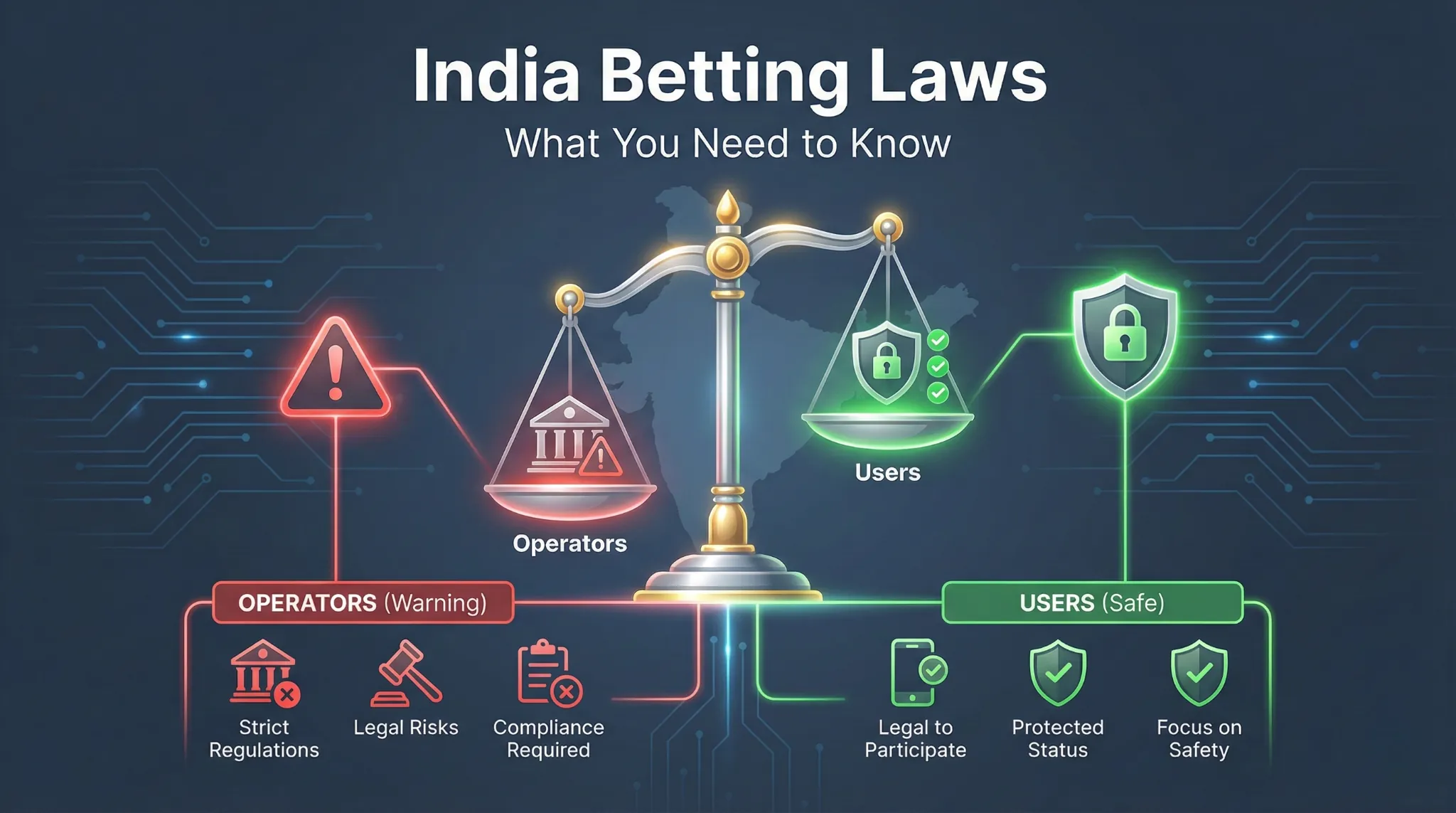
Indian gambling laws distinguish between operators and users. The significant penalties you may read about - imprisonment, heavy fines - apply to those running betting operations, not those placing bets.
Operators Face
- • Criminal prosecution
- • Imprisonment provisions
- • Heavy fines
- • Asset seizures
Individual Users Face
- • Zero reported prosecutions
- • Occasional payment blocks (solvable)
- • Tax obligations (normal)
- • Platform choice matters
The Legal Framework
Understanding the laws helps you make informed decisions. Here’s what exists on paper - and how it works in practice.
Public Gambling Act, 1867
This 159-year-old British law governs physical gambling. It predates the internet by over a century and doesn’t address online betting.
| On Paper | In Practice |
|---|---|
| Small fines (₹100-200) for gambling in a “gaming house” | Applied to physical gambling dens, not online betting |
BNS 2023 (New Criminal Code)
Section 112 includes “unauthorised betting or gambling” as “petty organised crime” with higher penalties on paper.
| On Paper | In Practice |
|---|---|
| 1-7 years for organised gambling operations | Targets gambling syndicates, not individual bettors |
PROGA 2025
The newest legislation affects online gaming platforms. The Supreme Court heard challenges on January 21, 2026 but has not issued a ruling as of April 2026; PROGA’s rules remain unnotified.
| On Paper | In Practice |
|---|---|
| Targets operators with up to 5 years + ₹1 crore fine | Focused on domestic platforms; not formally notified yet |
Read our full PROGA 2025 analysis →
FEMA (Foreign Exchange)
Technically restricts sending money abroad for gambling purposes.
| On Paper | In Practice |
|---|---|
| Penalties for foreign remittances to gambling sites | Enforced against large, obvious transfers; alternative payment methods operate outside this |
What Actually Happens
The gap between laws on paper and enforcement in practice is significant. Here’s the reality:
| Scenario | What Law Says | What Actually Happens |
|---|---|---|
| Betting on licensed international site | Grey area / PROGA claims coverage | Millions do it; zero prosecutions |
| Bank blocks transaction | Bank following RBI guidance | Use alternative payment methods |
| Winning money from betting | 30% TDS; declare as income | Standard tax obligation |
| Using VPN for betting | VPNs legal; underlying activity grey | Common practice; no enforcement |
| Crypto deposits for betting | Crypto regulated separately | Widely used; bypasses banking |
The Bottom Line
Zero individual online bettors have been prosecuted in India. Enforcement resources go toward illegal operators, money laundering networks, and match-fixing syndicates - not people placing bets on IPL matches through licensed international platforms.
Practical Guidance
Choose Licensed Platforms
The most important decision is where you bet. Licensed platforms offer:
- Regulated operations (MGA, UKGC, Curacao)
- Secure, guaranteed withdrawals
- Multiple payment options for Indian users
- Customer support and dispute resolution
See our recommended betting sites. We review Dafabet, Stake, 1xBet, and more.
Payment Methods That Work
Indian banks sometimes block gambling transactions. Solutions:
- Cryptocurrency: Bitcoin, USDT widely accepted (BC.Game specialises in crypto)
- E-wallets: Various international options
- Alternative processors: India-focused solutions (Parimatch handles UPI alternatives well)
- Prepaid cards: International virtual cards
Good platforms offer 5+ deposit methods specifically for Indian users.
Handle Taxes Properly
Betting winnings are taxable income. The straightforward approach:
- Keep records of deposits and withdrawals
- Declare net winnings as “income from other sources”
- 30% rate applies to gambling winnings
- Same process as declaring investment gains
Use our implied probability calculator to understand the true odds before placing bets.
Stay Informed
The regulatory market is evolving:
- January 21, 2026: Supreme Court PROGA hearing
- Potential skill game carve-out expected
- Fantasy sports may resume paid contests
- Regulation trend favours clarity
We update our legal guides after major developments.
What’s Fully Legal
Horse Racing
100% legal nationwide. 1996 Supreme Court ruling classified it as a game of skill. Bet at racecourses in Mumbai, Bangalore, Kolkata, Hyderabad.
Goa Casinos
10 licensed casinos (6 land-based, 4 floating). Table games, slots, poker - all regulated and legal. Popular: Deltin Royale, Casino Pride.
State Lotteries
Legal in 13 states including Kerala, Sikkim, and Nagaland. Government-run and privately operated under state licenses.
Summary
India's gambling laws are complex on paper but pragmatic in practice. The key takeaways:
- ✓ Individual bettors are not enforcement targets
- ✓ Licensed international platforms serve millions safely
- ✓ Payment solutions exist for any banking restrictions
- ✓ Horse racing and Goa casinos are fully legal options
- ⏳ The market is evolving — watch the January 21 ruling
Smart bettors choose reputable platforms, use appropriate payment methods, and handle their taxes properly. Always bet responsibly.
Related Guides
Is Betting Legal in India?
Complete guide to gambling in India - what's legal, what's available, and how millions bet safely.
PROGA 2025 Explained
Understanding the new legislation, its current status, and what the Supreme Court may decide.
Frequently Asked Questions
Are individual bettors prosecuted in India?
In practice, no. There are zero reported cases of individual online bettors being prosecuted in India. Enforcement resources focus on illegal operators, payment networks, and money laundering. Individual users of licensed international platforms face minimal legal risk.
What are the actual risks of online betting in India?
The risks are financial, not criminal. Banks may block some transactions (easily resolved with alternative payment methods). Choose reputable, licensed platforms to ensure fund security. Millions of Indians bet online without legal issues.
What happens if my bank blocks a gambling transaction?
This is common and easily manageable. Alternative payment methods are widely available - cryptocurrency, international e-wallets, and third-party processors. Reputable betting sites offer multiple deposit options specifically for Indian users.
Do I need to pay tax on betting winnings?
Yes, winnings should be declared as "income from other sources" when filing taxes. The 30% TDS applies to online gaming winnings. Maintaining records of your betting activity simplifies tax filing. This is similar to declaring investment gains.
What's the difference between operators and users under Indian law?
Indian gambling laws target operators - those running betting businesses. Penalties like imprisonment and heavy fines apply to operators, not players. Individual bettors using international platforms are not the focus of enforcement.
Is using international betting sites risky?
The key is choosing licensed platforms. Sites regulated by Malta (MGA), UK (UKGC), or Curacao offer player protections, secure payments, and reliable withdrawals. Millions of Indians use these platforms for IPL betting and other markets without issues.
Are penalties different in different Indian states?
Yes, gambling laws vary by state. Goa, Sikkim, and Daman have legal casinos. Maharashtra has no specific online ban. Some states have stricter rules on paper, but enforcement against individual users remains non-existent across India.
What about FEMA and sending money abroad?
FEMA technically restricts foreign remittances for gambling. In practice, this affects large, traceable bank transfers. Alternative payment methods (crypto, e-wallets) operate outside this framework. Individual bettors using standard deposit amounts face minimal FEMA scrutiny.