Back and Lay Meaning in Cricket Betting
What each bet means, what a lay can cost you, and IPL examples with every sum shown.
Back means you bet that something will happen, such as a team winning. Lay means you bet that it will not happen. When you lay, you take the bookmaker's side. If the outcome does not happen, you win the backer's stake. If it happens, you pay out your liability.
You place back and lay bets on a betting exchange, where users bet against each other instead of against a bookmaker. In Hindi, back is lagai and lay is khai, as our khai lagai guide explains.
The number to watch is the liability. A back bet can lose only your stake. A lay bet can lose stake × (odds − 1), which is more than your stake at odds above 2.00.
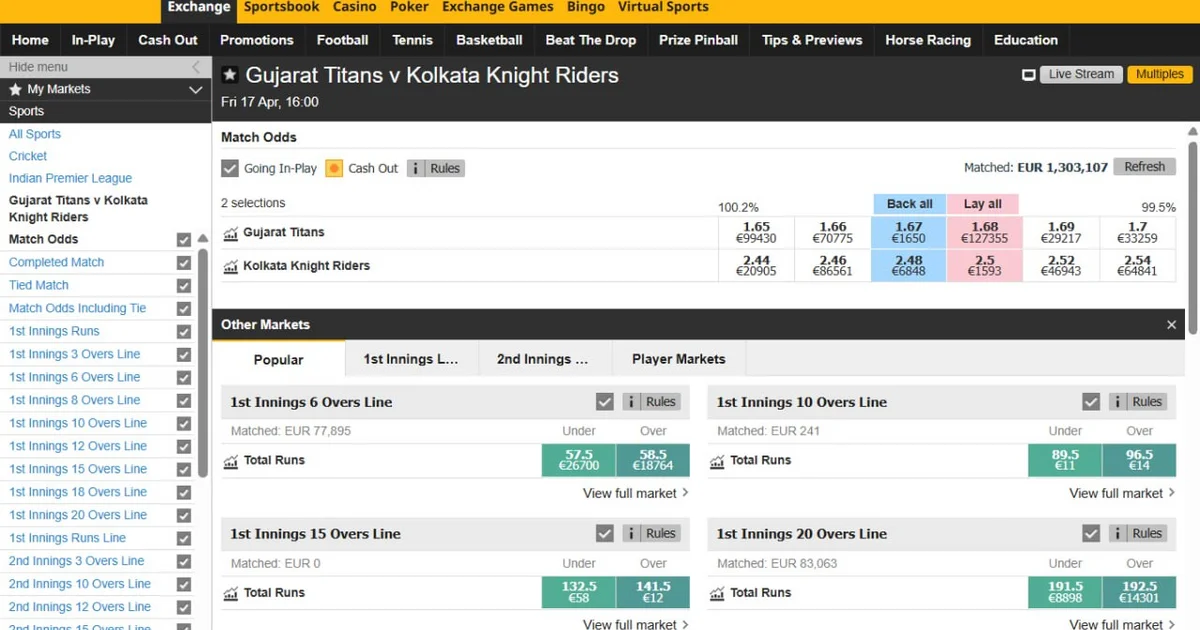
What Does Back Mean in Betting?
To back is to bet that something will happen, such as a team winning the match. Betfair calls it "the traditional form of gambling". It is the same bet a bookmaker takes from you.
If you are right, you get your stake back plus a profit of stake × (odds − 1). If you are wrong, you lose your stake. On Betfair's exchange, back prices sit in the blue boxes.
What Does Lay Mean in Betting?
To lay is to bet that something will not happen. You take the other side of someone's back bet, so for that one bet you act as the bookmaker. Betfair's own example: if you lay Manchester United to win, your bet wins if they lose or draw. In cricket, a lay on a team to win pays you if that team does not win.
Your lay stake is the backer's stake: the amount you win if you are right. If the selection wins, you pay the backer's profit instead. That payment is your liability. Betfair's guide says the liability, not the stake, is the amount taken from your account when you place a lay.
On Betfair's exchange, lay prices sit in the pink boxes. You cannot lay with a traditional bookmaker, because the bookmaker is always the layer.
What Is the Difference Between Back and Lay?
Back and lay are the two sides of one bet. When your back bet is matched on an exchange, another user has laid it, and the other way round. Here is the difference in one table.
| In short | Back | Lay |
|---|---|---|
| You bet that | It happens | It does not happen |
| You win | Stake × (odds − 1) | The backer's stake |
| You can lose | Your stake | Stake × (odds − 1), the liability |
| Betfair price box | Blue | Pink |
| Hindi word | Lagai (लगाई) | Khai (खाई) |
| At a bookmaker? | Yes | No |
How to Calculate a Lay Bet
One formula does it: liability = lay stake × (lay odds − 1). Betfair writes it as lay odds × backer's stake − backer's stake, which gives the same answer.
- Choose your lay stake. This is what you win if the selection does not win.
- Take 1 away from the lay odds.
- Multiply the two numbers. The answer is your liability, the most you can lose.
Here is what a ₹1,000 lay can cost you at different odds.
| Lay odds | Liability on a ₹1,000 lay | Chance the odds give the selection (1 ÷ odds) |
|---|---|---|
| 1.50 | ₹500 | 66.7% |
| 2.00 | ₹1,000 | 50% |
| 3.00 | ₹2,000 | 33.3% |
| 4.00 | ₹3,000 | 25% |
| 10.0 | ₹9,000 | 10% |
The last column is the chance the odds imply (1 ÷ odds), not how often such teams really win. Your lay wins when the selection does not win, so at 10.0 the odds give your lay a 90% chance.
What Is Back and Lay in IPL Betting?
The back and lay meaning is the same in IPL betting as anywhere else. You back a team you think will win, or lay a team you think will not. Here is a made-up match with round numbers.
Say an exchange shows Chennai Super Kings to win at 1.80 to back and 1.82 to lay. You can take either side.
Back CSK ₹1,000 at 1.80
- If CSK win: +₹800 profit (₹1,000 × 0.80).
- If CSK do not win: −₹1,000, your stake.
- The most you can lose is ₹1,000.
- After 5% commission on the win: +₹760.
Lay CSK ₹1,000 at 1.82
- If CSK do not win: +₹1,000, the backer's stake.
- If CSK win: −₹820, your liability (₹1,000 × 0.82).
- The most you can lose is ₹820.
- After 5% commission on the win: +₹950.
The lay price is a little higher than the back price. That gap is called the spread. In the screenshot above, Gujarat Titans could be backed at 1.67 and laid at 1.68.
The 5% commission rate here is only an example. Rates differ by exchange and by market, as the commission section below shows.
Back and Lay Meaning in Hindi: Lagai and Khai
In Hindi betting talk, back is lagai (लगाई) and lay is khai (खाई). Lagai comes from lagana, "to place". Khai is commonly linked to khana, "to eat": the layer "eats" the backer's stake when the backed side fails.
हिंदी में: Back का मतलब लगाई है, यानी आप दांव लगाते हैं कि कोई नतीजा होगा। Lay का मतलब खाई है, यानी आप दांव लगाते हैं कि वह नतीजा नहीं होगा।
The back and lay meaning does not change in Hindi. The words map one to one. "Lagai CSK at 1.80" means the same as "back CSK at 1.80", and a khai carries the same liability as a lay. In India, a green book is often called a book set. Our khai lagai guide covers where the words come from, with a full IPL example.
How Does a Betting Exchange Work?
A betting exchange is a market where users bet against each other. The exchange does not set the odds. Users do, by asking for a price or taking one that someone else offers. As Betfair puts it, the exchange "does not set the odds – you do!"
A bet only stands once another user matches it. Each price box also shows how much money is waiting at that price. Betfair warns that if only a little money is waiting, your bet may not be fully matched.
Betfair earns from commission, not from the odds. It says there is "no margin for profit built into any market". In the screenshot above, 1 ÷ 1.67 + 1 ÷ 2.48 = 100.2%, so the two back prices add up to almost exactly 100%.
Bookmakers work the other way. They set the odds and keep a margin inside them. Over 38 matches from July to September 2026, Dafabet's sportsbook had an average margin of 4.36% in our odds data, against 5.47% for the other bookmakers we track.
| In short | Exchange | Bookmaker |
|---|---|---|
| Takes your bet | Another user | The bookmaker |
| Sets the odds | The users | The bookmaker |
| Can you lay? | Yes | No |
| Margin in odds | None added by Betfair | 4.36% (Dafabet) and 5.47% (others) in our odds data |
| You pay | Commission on net winnings | The margin, inside the odds |
| Bet stands when | When another user matches it | When the bookmaker accepts it |

Where to back and lay: Dafabet Exchange.
Our Dafabet review says Dafabet runs a betting exchange where you can back and lay cricket, football and tennis, and trade positions in-play. It says liquidity varies by sport but is usually enough on major cricket matches.
Go to DafabetGreening Up: Back First, Then Lay
Greening up means you back a selection, then lay the same selection later at shorter odds, so you make the same profit whatever the result. Betfair's glossary calls the result a green book, a position that lets you "profit regardless of the outcome of the event".
The lay stake for an even green book is: lay stake = back stake × back odds ÷ lay odds.
Worked green book example
You back India for ₹1,000 at 2.50 before the match. During the match, India's price shortens to 2.00. Your lay stake is ₹1,000 × 2.50 ÷ 2.00 = ₹1,250.
If India win, the back pays ₹1,500 profit and the lay costs its ₹1,250 liability: +₹250. If India do not win, the back loses ₹1,000 and the lay wins ₹1,250: +₹250.
At a 5% rate, commission is ₹12.50 and you keep ₹237.50 either way. Commission is charged once, on your net winnings on the market, not on each bet. Check your own numbers in our Khai-Lagai Calculator.
The profit is locked only once your lay is matched. Until then you still hold an open back bet, and the price can move away from you.
It also works the other way round. Betfair describes trading as a chance to "lay something not to happen at lower odds, then back it at a higher price". Lay ₹1,000 at 1.60, a liability of ₹600. If the price drifts to 2.00, back ₹1,000 × 1.60 ÷ 2.00 = ₹800. You make ₹200 whichever way the match goes, or ₹190 after 5% commission.
How Does Exchange Commission Work?
On Betfair, commission is charged on your net winnings on each market, not on every bet. Its glossary defines commission as "the amount you are charged by Betfair on your net winnings on an Exchange market".
So if you place five bets on one IPL match and finish that market ₹200 up, a 5% rate costs you ₹10. If you finish the market down, you have no net winnings, so you pay no commission. You can place many bets on one market without paying a fee on each.
Rates differ by exchange and by market. Betfair's help page for its Australian exchange lists a base rate of 6% on sports markets (checked on 26 September 2026). The same page says each market's rate is shown in its "Rules" section. Check the rate on your own exchange before you trade.
Common Back and Lay Mistakes
1. Treating the lay stake as your risk
Your lay stake is what you win. Your liability is what you risk. The two are equal only at odds of 2.00, and at 4.00 a ₹1,000 lay risks ₹3,000. Check the liability before you confirm every lay.
2. Laying long odds because the lay usually wins
At 10.0 the odds give your lay a 90% chance. On those chances, ten ₹1,000 lays win ₹1,000 nine times and pay ₹9,000 once, so you break even before commission. With 5% commission on the nine wins, you end ₹450 down.
3. Forgetting the commission
Commission comes off your net winnings. In the green book example above, a 5% rate turns ₹250 into ₹237.50. Count it before you trade on thin margins.
4. Leaving the green book half done
A green book exists only once your lay is matched. If you wait for a better price and the odds drift back out, the profit can vanish. Until the lay is matched, you hold an open back bet.
Is Back-Lay Betting Legal in India?
Indian betting law changed significantly with the Promotion and Regulation of Online Gaming Act (PROGA) 2025, which bans real-money online gaming. The Supreme Court heard a constitutional challenge in January 2026; no ruling has been issued to date. Enforcement targets operators and payment networks, not individual bettors, and no individual-user prosecutions under PROGA have been publicly reported.
Offshore platforms remain accessible to Indian users and continue to serve the majority of the cricket-exchange audience. For the full current position including state-level nuance, see our complete guide to Indian betting law.
Back and Lay: Questions and Answers
What do back and lay mean in betting?
Back means you bet that something will happen, such as a team winning. Lay means you bet that it will not happen. When you lay, you take the bookmaker's side: you win the backer's stake if the outcome does not happen, and you pay your liability if it does.
What is the difference between back and lay bets?
A back bet wins if the outcome happens, and the most you can lose is your stake. A lay bet wins if the outcome does not happen, and the most you can lose is your liability: stake × (odds − 1). On Betfair's exchange, back prices sit in blue boxes and lay prices in pink ones.
What is lay betting?
Lay betting is betting that something will not happen. You act as the bookmaker for one bet. If the selection does not win, you keep the backer's stake. If it wins, you pay the backer's profit, which is your liability. You can lay on a betting exchange, but not with a traditional bookmaker.
How do you calculate a lay bet?
Use liability = lay stake × (lay odds − 1). Lay ₹1,000 at 1.50 and your liability is ₹500. At 3.00 it is ₹2,000, and at 10.0 it is ₹9,000. If the selection does not win, you win the ₹1,000, less any commission. Our Khai-Lagai Calculator does the sums for you.
What is back and lay in IPL?
It means the same in the IPL as anywhere else. You back a team you think will win, or lay a team you think will not win. Lay Chennai Super Kings for ₹1,000 at 1.82 and you win ₹1,000 if CSK do not win, or pay ₹820 if they do.
What do back and lay mean in Hindi?
In Hindi betting talk, back is lagai (लगाई) and lay is khai (खाई). Back का मतलब लगाई है, यानी आप दांव लगाते हैं कि कोई नतीजा होगा। Lay का मतलब खाई है, यानी आप दांव लगाते हैं कि वह नतीजा नहीं होगा। So khai lagai is the same as back and lay. See our khai lagai guide.
What is liability in lay betting?
Liability is the most you can lose on a lay bet: what you pay if the selection wins. The formula is stake × (odds − 1). Betfair's guide says the liability is the amount taken from your account when you place a lay. At odds above 2.00 it is more than your stake.
How does exchange commission work?
On Betfair, commission is charged on your net winnings on each market, not on every bet. Finish an IPL market ₹200 up at a 5% rate and you pay ₹10. Finish it down and you pay nothing. Rates vary by exchange and by market, so check the market's rules.
What is greening up or a green book?
Greening up means you back a selection, then lay it later at shorter odds, so you make the same profit whatever the result. The lay stake is back stake × back odds ÷ lay odds. Back ₹1,000 at 2.50, lay ₹1,250 at 2.00, and you make ₹250 either way before commission. Try it in our Khai-Lagai Calculator.
Where can I back and lay in India?
Our Dafabet review says Dafabet runs a betting exchange where you can back and lay cricket, football and tennis. Our Betfair review says Betfair.com does not accept players from India.
Is back-lay betting legal in India?
India's Promotion and Regulation of Online Gaming Act (PROGA) 2025 bans real-money online gaming. A Supreme Court constitutional challenge is pending with no ruling to date. Enforcement targets operators, not individual bettors. Offshore platforms remain accessible. See our complete guide to Indian betting law.
Is back or lay betting riskier?
It depends on the odds. A back bet can lose only its stake. A lay bet can lose stake × (odds − 1): less than your stake at odds below 2.00, and nine times your stake at 10.0. Work out the liability before you place any lay.
Continue Reading
Work Out the Liability Before You Lay
Enter the odds and your stake, and the calculator shows the lay stake, the liability and your profit.
Back and lay on Dafabet Exchange.
Our Dafabet review says its exchange covers cricket, football and tennis. Check its commission rate before you trade.
Go to Dafabet